
Why Your Norfolk Rank Tracker Is Lying About Your Actual Local Leads
It is Monday morning in Norfolk. You open your email to find the weekly report from your SEO agency. You see a sea of green: “Rank #1” for your primary keywords. You should be ecstatic. However, as you look at your service schedule for the week, the phones aren’t ringing. The leads aren’t coming in. You start to wonder: if I am number one on Google, why am I not busy? The truth is that your google business profile seo strategy might be built on a foundation of “vanity metrics” that traditional rank trackers are more than happy to feed you.
In 2026, the local search landscape has shifted. We are no longer in an era where a single ranking number tells the whole story. Between the rise of AI-driven search snapshots, hyper-local proximity filtering, and the way Google handles mobile intent, a “Rank #1” status in a spreadsheet often translates to “Invisible” on the actual streets of Norfolk. As a Local SEO consultant, I have seen hundreds of Virginia business owners get lured into a false sense of security by these reports. If you want to actually rank higher on google maps and turn those views into revenue, you have to understand why your current tracker is lying to you.
The Illusion of the “Average” Rank in Norfolk
Traditional rank trackers operate on a “point-in-time” or “average” logic. They simulate a search from a specific IP address or a generalized zip code and tell you where you stand. But Google’s local algorithm doesn’t work in averages. It works in meters and blocks. A plumber might rank #1 when searched from a desk in Ghent, but by the time the user drives down to Ocean View or crosses the bridge into Portsmouth, that same plumber has dropped to position #7 or lower.
When your tracker tells you that you are “Average Rank 1.5,” it is often smoothing over the massive “dead zones” where your business is completely invisible. This is precisely What your Norfolk local SEO reporting is hiding about your actual leads. If your visibility is concentrated in a three-block radius around your office, but your service area covers all of Hampton Roads, your rank tracker is giving you a dangerously incomplete picture.
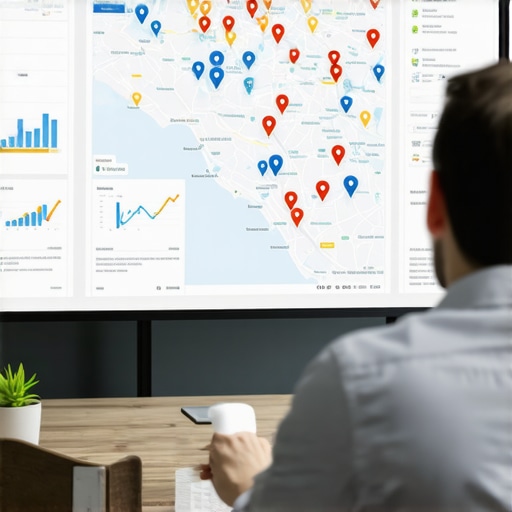
To get a true sense of your performance, you need to move away from static keyword lists and toward geo-grid technology. Research from industry leaders like Nightwatch and Local Falcon confirms that accuracy in local search is entirely dependent on the density of the data points. If you aren’t checking your rankings every 500 meters across Norfolk, you aren’t seeing what your customers are seeing. You need robust local seo tools that can map out your “visibility heat map” rather than a simple list of numbers.
The “Proximity Ghost” and the Hidden Filtering of 2026
One of the most frustrating phenomena for Norfolk business owners is the “Proximity Ghost.” You might have more reviews, a better-optimized profile, and a faster website than your competitor, yet you still find yourself excluded from the Local 3-Pack. This often happens because of Google’s proximity filter. Google aims to provide variety in its results; if there are three law firms or three HVAC companies located in the same office park or the same block of Downtown Norfolk, Google will often “hide” or filter out the ones it deems redundant to provide a more diverse set of options to the user.
Your rank tracker might show you at #1 because it’s “poking” the algorithm in a way that doesn’t trigger the filter, but a real-world user searching from a different angle will see your competitor instead. Knowing How to tell if your Norfolk map pin is being filtered by a proximity ghost is the difference between scaling your business and spinning your wheels. If you are located in a high-density “cluster” of similar businesses, your google business profile seo needs to focus on “authority signals” that force Google to pick you over the neighbor next door.
Using a google business profile audit tool can help you identify these filtering issues. By analyzing the “centroid” of your industry in Norfolk, you can determine if your physical location is actually working against you and what specific content or backlink strategies you need to employ to break through the filter.
The 2026 AI Snapshot Gap: Beyond the 3-Pack
As we move through 2026, the traditional “Local 3-Pack” is no longer the only game in town. Google’s Search Generative Experience (SGE) and AI-driven snapshots are fundamentally changing how users interact with local data. When a user asks, “Who is the best roofer in Norfolk for emergency leak repair?” Google’s AI doesn’t just look at who is ranked #1. It synthesizes data from reviews, website content, and third-party mentions to provide a conversational recommendation.
Most google maps rank tracker tools are still built to monitor the old-school 3-Pack. They are completely blind to whether or not your business is being cited in an AI snapshot. This is a massive gap in your data. If the AI is recommending your competitor because their website mentions “emergency leak repair” more authoritatively, your #1 rank in the 3-Pack might be getting bypassed entirely by users who click the AI suggestion first.
Staying ahead requires implementing 3 Norfolk SEO Tweaks for Better 2026 Map Visibility. This includes optimizing for “conversational intent” and ensuring your business data is consistent across not just Google, but also ChatGPT’s search integrations and Apple Maps. If your local seo software isn’t tracking these multi-platform AI citations, it’s lying to you about your actual market share.
The Lead-Gen Trap: Why Clicks Don’t Equal Conversions
We have all seen it: a Google Business Profile (GBP) that gets thousands of impressions and hundreds of clicks, yet the “Calls” metric in the dashboard remains stagnant. This is The lead-gen trap: Why your Norfolk GMB clicks aren’t turning into sales. High rankings can often attract “looky-loo” traffic – people who are just looking for your address to complain, or people looking for a service you don’t actually provide but that you happen to rank for due to a broad keyword strategy.
For example, a Norfolk law firm might rank #1 for “legal advice,” attracting hundreds of clicks from people who want free help. Meanwhile, they are invisible for “personal injury attorney Norfolk,” which is where the actual revenue is. A standard tracker will tell you that you are “winning” because your traffic is up, but your bank account will tell a different story. To fix this, you must use a google business profile audit tool to analyze the “intent” behind your traffic. Are people clicking your “Call” button, or are they just clicking your website and bouncing immediately? Real google business profile seo focuses on high-intent conversion actions, not just raw visibility.
Why Your Rivals Outrank You with Less Effort
It can be maddening to see a competitor in Virginia Beach or Norfolk who has half your reviews and a terrible website outranking you in the Map Pack. You check your GBP ranking tools, and they confirm the worst: you’re stuck at #4, just outside the money zone. Why? Often, it comes down to “Foundational Authority” and “Category Dilution.”
Research, including data from RightResponse AI, shows that the “Primary Business Category” is the single most important ranking factor for Google Maps. If you have selected a primary category that is slightly off-target, or if you have cluttered your profile with too many secondary categories, you are diluting your relevance. Your rivals might be outranking you simply because their profile is “cleaner” in Google’s eyes. This is Why your Virginia business listing gets buried despite having the best reviews. They aren’t doing more work; they are doing more “accurate” work.
To diagnose this, you need a google maps ranking service that looks beyond your profile and analyzes the “Category DNA” of the top 3 winners in your specific Norfolk niche. If all the winners are categorized as “Real Estate Attorney” and you are categorized as “Law Firm,” no amount of review-gathering will close that gap.
Action Plan: Auditing for Reality in the Norfolk Market
If you are ready to stop being lied to by vanity metrics and start capturing real leads, you need a new approach to your local strategy. Follow this three-step roadmap to audit your business for the reality of 2026:
- Step 1: Shift to Geo-Grid Monitoring. Stop using trackers that give you a single city-wide rank. Use a google maps rank tracker that provides a 13×13 or 15×15 grid of your actual rankings across Norfolk, Chesapeake, and Virginia Beach. This will show you exactly where your “visibility holes” are.
- Step 2: Audit Your Categories and Attributes. Ensure your Primary Category is a perfect match for your most profitable service. Use Google’s “Justifications” (the small snippets of text that say “Their website mentions…”) to your advantage by updating your website content to match local search intent.
- Step 3: Prioritize Behavioral Signals. Google tracks how people interact with your profile. High “dwell time” on your photos and frequent “Request a Quote” interactions are more powerful ranking signals in 2026 than keyword density. Use local seo tools to monitor these conversion actions closely.
Conclusion: Stop Chasing Numbers, Start Chasing Growth
At the end of the day, a rank tracker is just a tool, not the truth. The only metric that truly matters for your Norfolk business is whether or not your google business profile seo is putting money in the bank. If your reports are green but your phone is silent, it is time to stop trusting the “average” and start looking at the hyper-local reality of your market.
Don’t let your business get left behind by the AI shift or the proximity filter. It is time for a real google business profile optimization strategy that focuses on leads, not just positions. If you’re ready for a deep-dive, Norfolk-specific audit that exposes what your current reports are hiding, contact me, Kevin Pauls, today. Let’s build a visibility map that actually drives your business forward.